Thermal direct joining opens up new possibilities for metal-plastic assembly. The process creates highly durable and media-tight joints without the need for adhesives or additional fastening elements. The technology is to be transferred into further application areas.
Products are becoming increasingly compact and lightweight, while are expected to convince in respect to functionality and sustainability. Metal is often used only where mechanical strength, electrical conductivity, or thermal management are indispensable. Most other functions are fulfilled by plastics, which can be processed economically through injection molding while offering a high degree of design freedom.
This development promotes advanced joining technologies. But mechanical fasteners require additional installation space, increase part count, and add assembly effort, whereas adhesive bonding often complicates recycling and repair processes.
Especially against the backdrop of “Right to repair” initiatives, joining solutions are in demand that combine long-term reliability with the option to be disassembled when required. The challenge is to achieve high process stability, material efficiency, and sustainability within a single joining concept.
Micro-mechanical interlocking
A promising answer is thermal direct joining which creates a direct bond between metal and plastic through a combination of micro-scale force-fit and form-fit mechanisms.
To achieve this, the metal surface is first roughened. The joining partners are then pressed together under a defined force while the metal component is heated inductively. The heat at the interface causes the plastic to melt locally and flow into the microscopic surface structures. Once cooled, the material solidifies and creates a highly robust, media-tight connection.
A key factor for industrial viability is the specially developed joining tooling. These tools enable highly concentrated heating within just a few hundred milliseconds, resulting in extremely short cycle times. At the same time, precise force-displacement control allows continuous monitoring and regulation of the process. This ensures consistent joint quality and the reproducibility required for large-scale manufacturing.
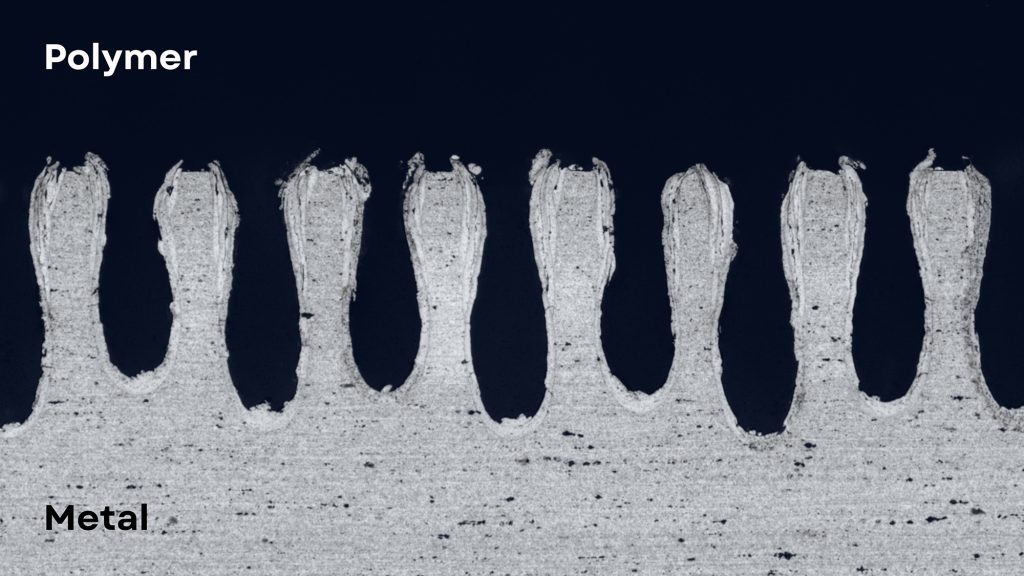
Representative cross-section of the joining zone of a metal-plastic joint produced by thermal direct joining (© enabling connections GmbH)
Applications and next steps
Thermal direct joining is particularly attractive wherever compact designs, leak-tightness, and functional integration are critical requirements. The technology has already demonstrated its capabilities across a wide range of industries such as medical devices, household appliances, and cooling solutions for power electronics.
It also offers significant potential for high-volume automotive assembly. Eliminating screws, inserts, and adhesives enables more compact component designs, supports lightweight construction strategies, and reduces both material consumption and assembly effort.
The next stage of development focuses on controlled disassembly, so that joined components can be separated using dedicated tools without damage. In operation, the connection remains highly durable and tamper-resistant, while still allowing access for service, maintenance, or repair when necessary, thus bringing the benefits of direct metal-plastic joining to an even broader range of industrial products.
Even as of today, by reducing or eliminating screws, adhesives, and oversized flange geometries, thermal direct joining makes a meaningful contribution to sustainable product design.
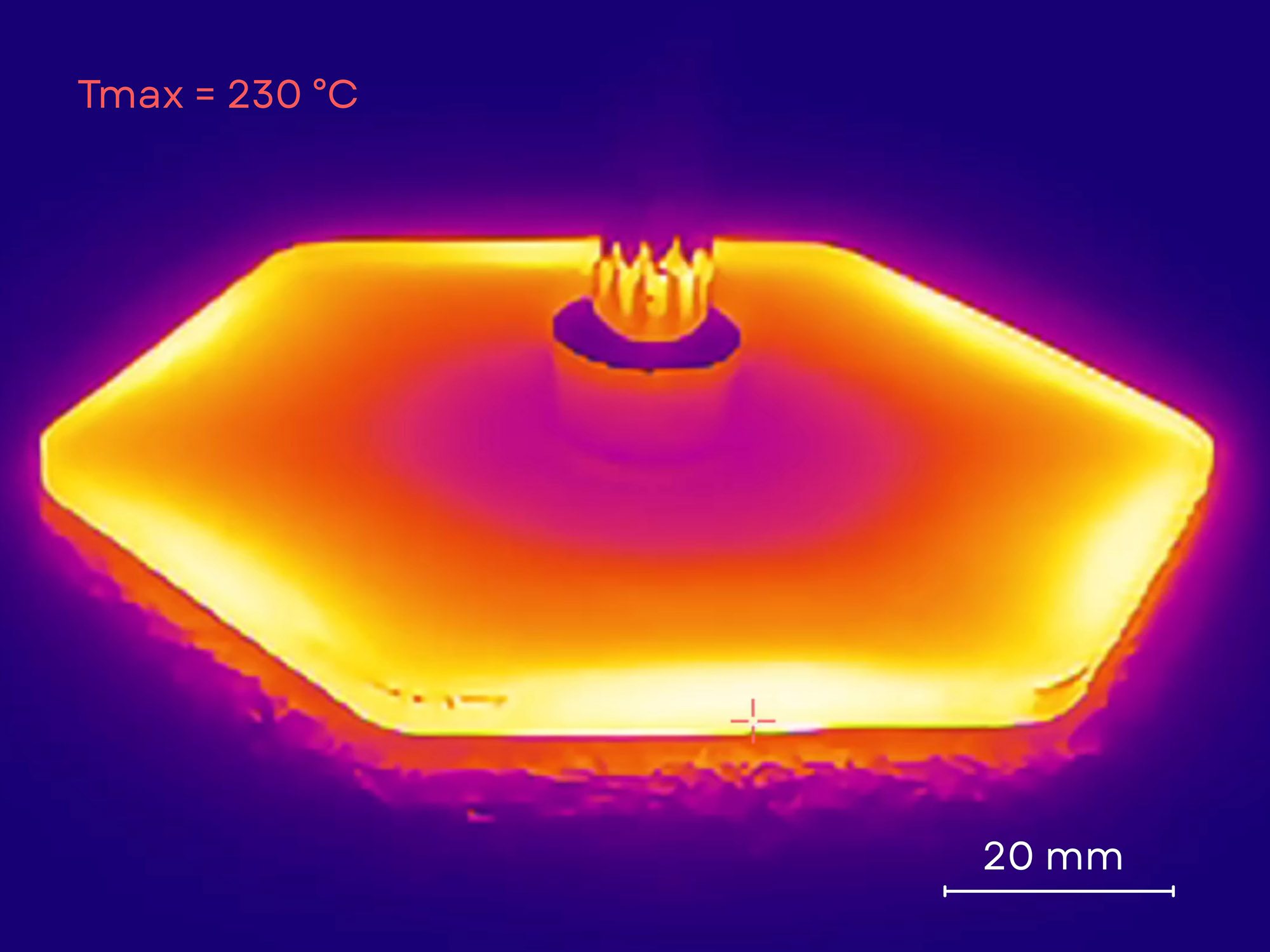
Temperaturverteilung infolge induktiver Wirbelstromerwärmung in
einer 2 mm starken Aluminiumplatte (© enabling connections GmbH)
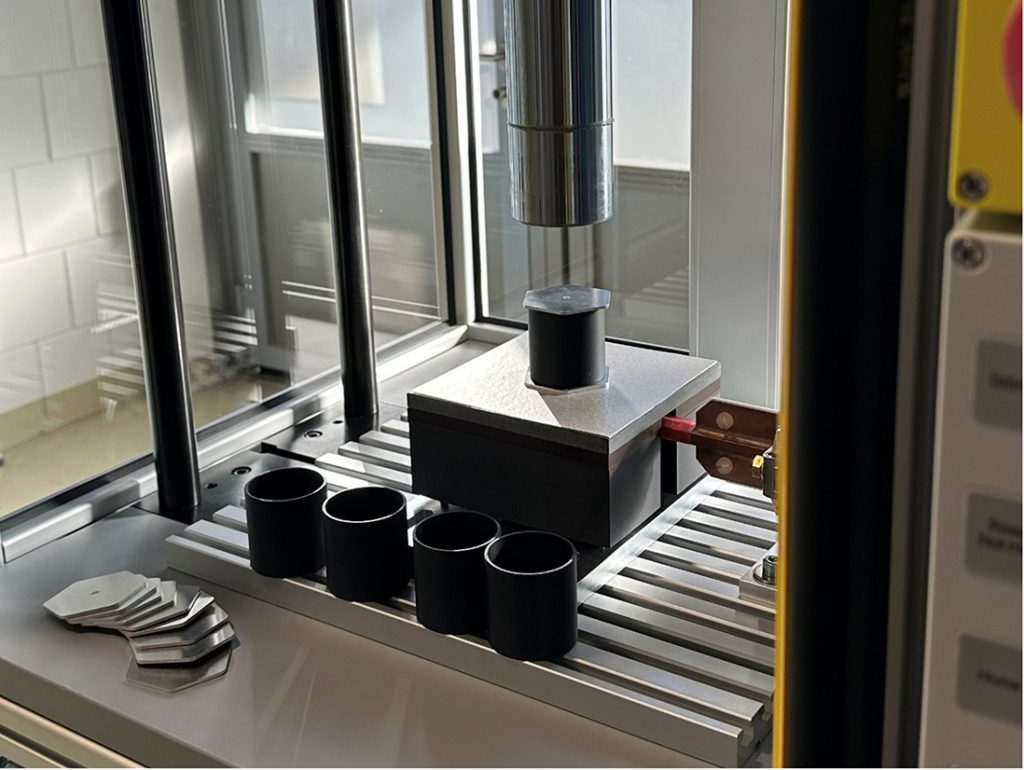
Industrial joining cell for the thermal direct joining of metal and plastic components (© enabling connections GmbH)
Contact:
enabling connections GmbH, Radeberg
Annett Klotzbach, Co-Founder
+49 151 42 81 64 81
a.klotzbach@enablingconnections.de
www.enablingconnections.de