26 sprints in two years created the most performant battery housing in electric aviation
A battery enclosure for electric aircraft is not simply a container, but a safety-critical component. An eVTOL programme demonstrates how its requirements can be met: not through simulation and specifications, but through an integrated development process that closely links design, manufacture and testing.
It all began as a typical build-to-print project. The client was convinced of his design, and production proceeded according to specifications. However, when put to the test, the theoretically derived design did not hold up: the housing failed the thermal runaway test.
So the client launched a development competition. The winning design did better in the thermal runaway test whilst being around 40 % lighter than the competing proposals. Maximum component integration, minimal sealing surface, few fasteners, large pouch cells. However, new regulatory requirements quickly rendered this generation obsolete, which is rather common in the still-nascent eVTOL segment.
Four weeks to learn and implement
The thermal runaway generated temperatures in excess of 2,000°C and pressures of around 6 bar, whilst a highly abrasive jet of particles struck the surrounding structure. A simple laminate would burn through in less than a second. As the associated effects cannot be predicted mathematically, the customer’s specified production deadline could only be met through high-frequency, experiment-based development. The programme therefore ran on a fixed four-week cycle. Two weeks for the joint design and construction of five test housings in each phase, one week for assembly at the customer’s site, and one week for thermal runaway testing with production cells, including a joint post-mortem inspection.
The findings formed the basis for the next design. This process continued for two years without interruption. Each iteration tackled a specific sub-problem: abrasion protection, external ignition, particle separation, propagation between modules, and so on. Once one problem was solved, the focus shifted to the next.
The result is a complex multi-material component with a locally adapted layer structure, in which up to 20 materials work together. It provides structural support, insulates against high voltage, electrically connects all parts, provides electromagnetic shielding, keeps the cells prestressed, separates them airtight and yet allows them to vent at low pressure.
From the very beginning, the prototypes were built by staff from the series production department. Their feedback on manufacturability was incorporated into each subsequent design. Industrialisation began in parallel with the final phase of development, whilst at the same time the test procedures – including test points within the component – were established: leak-tightness, earth resistance and so on.
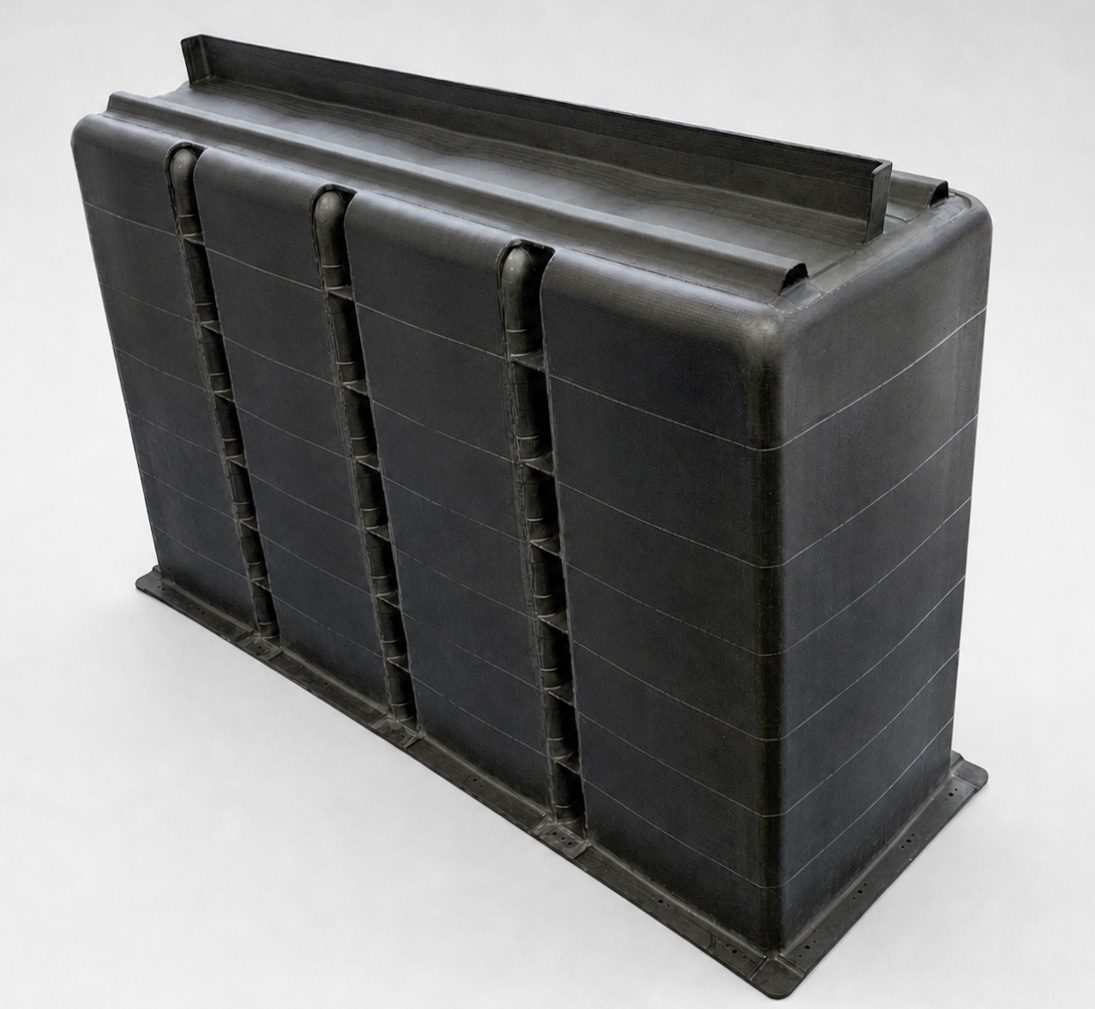
This battery casing, cast in one piece, could accommodate 216 pouch cells, or 72 kg of cell mass (© Cotesa)
The lesson is not a technical one
Expertise in materials, their compatibility, test procedures and design principles is essential for developing complex and innovative aerospace components in the shortest possible time. Areas that must be mastered beyond mere composite and manufacturing expertise include electrical insulation and earthing in load-bearing fibre-reinforced composite structures, thermal behaviour and targeted conductivity, fire behaviour in multi-layer structures, and documentation to meet regulatory requirements – regardless of whether the project involves an eVTOL, a drone or any other aircraft.
The real lesson, however, is neither technical nor regulatory: closely integrating development, prototyping, testing, and preparation for series production, shorten development times, reduces development costs and ensures efficient series production.
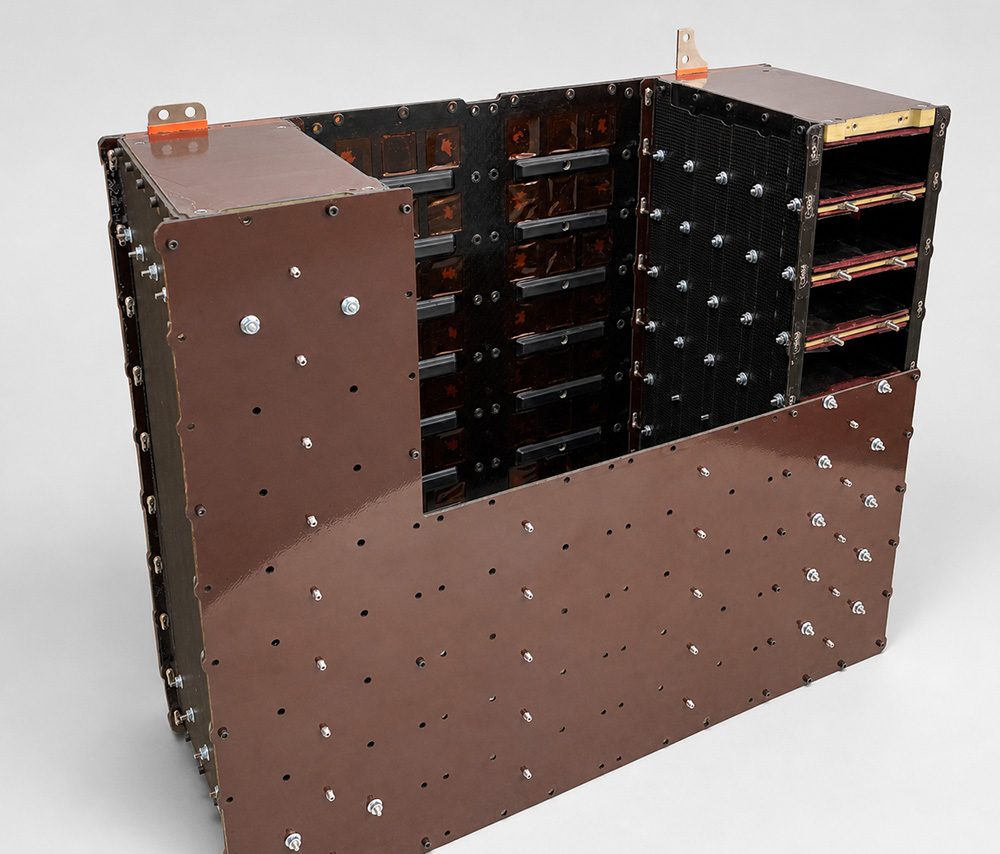
The final battery housing was constructed using a differential design to allow for a more flexible response to changing requirements set by the regulatory authorities (© Cotesa)
Contact:
COTESA GmbH, Mittweida
Dipl.-Ing. Jerome Rossol, Head of Innovation
+49 151 54 44 10 29
rossol@cotesa.de
www.cotesa.de